Internet Marketing Party
How David Gonzalez Kept Austin's Internet Marketing Party Alive for 18 Years

This week's Founder Friday is about one of Austin's longest-running marketing communities, and the unusual think-tank format that has kept it alive for almost 18 years.
David Gonzalez didn't set out to build an Austin institution. But for nearly two decades, Internet Marketing Party has quietly proved that the highest-leverage thing in a community isn't always the room, the speaker, or even the guest list. It's the format.
David has mastered the art of architecting deals — and architecting the rooms where deals happen. At his think tanks, solutions are banned for the first hour, and everyone around the table is only allowed to ask clarifying questions. Surprisingly, 20–40% of the time, that hour of questions is more valuable than the answers that follow — and the experts often walk away with as much value as the founder in the hot seat.
What founders can steal from this:
- Better questions create better answers
- Relationships compound when you keep the upside
- Trade things of unequal value
Here's what David shared about the think-tank format, trading things of unequal value, and why Austin is uniquely built for community...
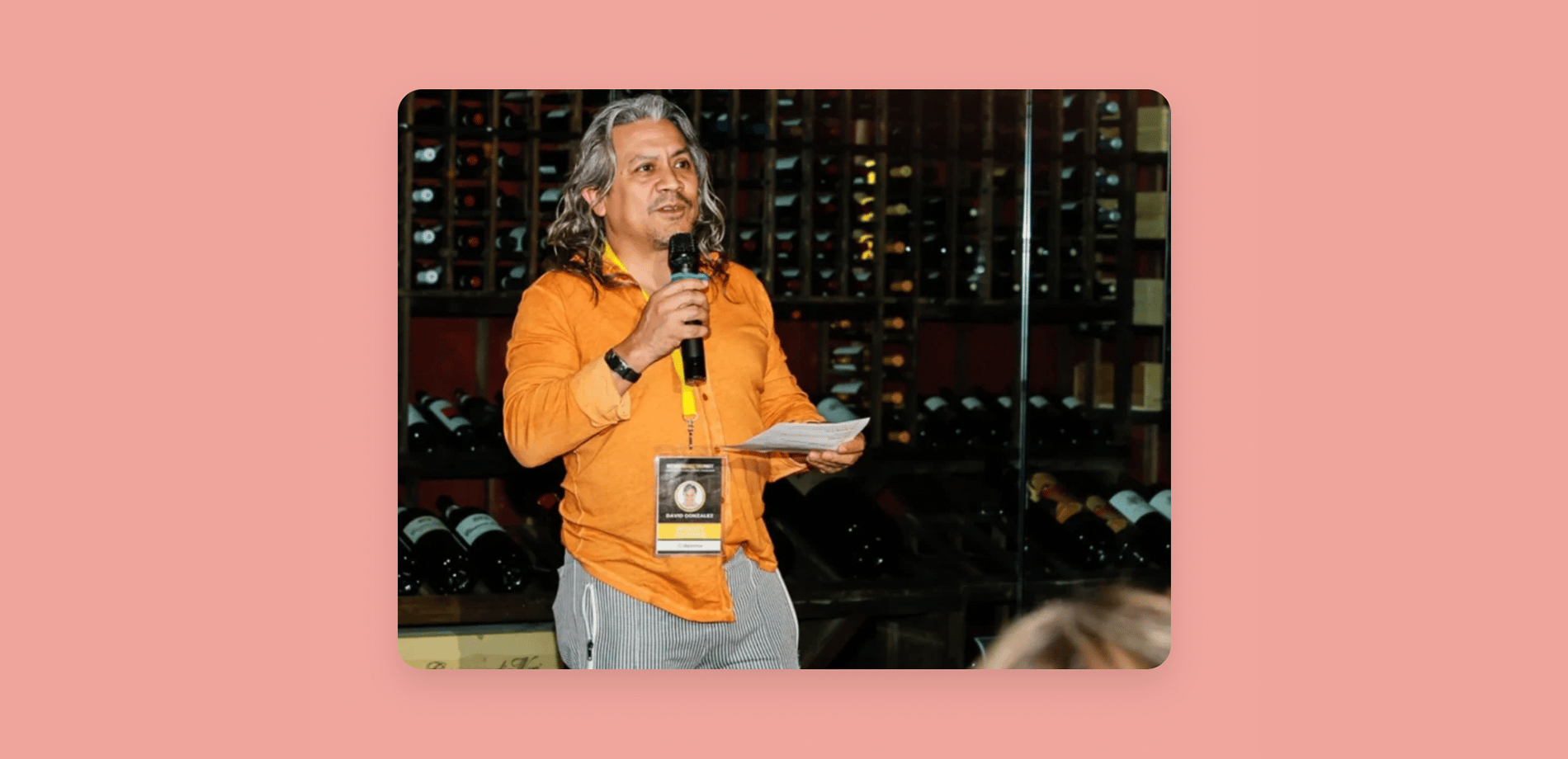
What is Internet Marketing Party, and how did it start?
I sold a business I'd been running for nine years and didn't know what was next. I got into real estate right at the 2008 crash, which didn't feel right. Then I was at a Kinko's, saw The 4-Hour Workweek in their book section, and didn't put it down until I'd finished. I realized I wanted a lifestyle business.
My friend Michael Lovitch introduced me to a network of affiliate marketers who were doing tens of millions for big product launches. They needed an affiliate manager, and Michael said, "Do it as an agency, not a job, so you get the relationships." That gave me a Rolodex from day one. They were hosting a monthly meetup in Dallas, and on one of the drives back, someone said, "Why are we driving all the way to Dallas? We've got plenty of marketers in Austin." My friend Eric posted on the Warrior Forum that I was hosting an internet party on a specific date in September 2008. I called Six Lounge downtown, asked if I could have the bar on a Wednesday night, and about 50 people showed up. We've done one every month for almost 18 years.
How does the think tank format work, and why does it work?
I'd ask each speaker, "What's a challenge in your business that, if we solved it, would equal a six or seven figure win?" Based on their answer, I'd find experts who had actually solved that exact problem. We'd put them around a table. First 15 minutes, ground rules. Everyone gets one minute to say what earns them the right to be in that chair. Then for an hour, nobody is allowed to give any solutions. All we can do is ask clarifying questions.
Three reasons. One, when you're a hammer, everything is a nail, so all the experts want to solve it the way they would. Two, you have to earn the right to influence. Three, it creates a sacred space where people realize their default advice wouldn't fit because of X, Y, or Z. We found that 20 to 40% of the time, the question portion was more important than the actual solutions. The quality of the questions tells you more about a person than the answers do. The experts often got as much value as the person in the hot seat.
What does "trading things of unequal value" mean in practice?
One man's junk is another man's treasure. What's easy for me might be hard for you, and vice versa. Here's a real example. I had a client whose business was approaching a million a month in revenue. I worked hard to introduce her to someone who had 600,000 of her perfect audience as subscribers. At a conference I told her, "I just made a deal for you with 600,000 subscribers." She said, "Oh, cool," and walked off.
A few minutes later my business partner Gonzalo Paternoster called her and told her he'd fixed something in her operations that was going to save her three hours a day. She was over the moon. I called Gonzalo from the airport and admitted I was frustrated. He said, "For you, making a million a month is the holy grail. For her, once she'd made it, she realized money didn't solve her bigger problems. When you brought her 600,000 subscribers, she heard, 'That's more work.' Saving her three hours a day meant she could go to the pool." Trading things of unequal value.
Why is Austin the right place for this kind of community work?
I don't think there's a more set-up city in the US right now. New York hasn't been the same since COVID. LA isn't what it used to be. SF has visible problems on the streets that go beyond what the news shows. Miami is about fun more than work. Chicago isn't where I'd go to build something innovative. Austin attracts everybody — Elon, Mark Zuckerberg, Joe Rogan — while still having Willie Nelson and Matthew McConaughey keeping it earthy and human. People here are uniquely willing to help each other.
There's a flip side. My friend Amber Spears, who runs a very successful mastermind, told me, "Austin is fantastic if you're an entrepreneur, because there's so much community. But for paid events, no. Everyone wants to come for free or wants a discount, and nobody bought when we tried to upsell." The same generosity that makes Austin great for community makes it harder if your model depends on charging that community. That's part of why I'm moving toward being part of communities instead of always leading them.
What advice do you have for someone coming up in Austin's entrepreneurship scene?
Take real stock of yourself first. Ask your AI, on a scale of 1 to 10 — where 10 is fully sourced, full of integrity, you keep your word, people can count on you, and 1 is you're a drag, your word means nothing — to be brutally honest. If you're below a six or seven, start there. Otherwise it's like trying to get into Yale without knowing arithmetic.
Then ask what your vision actually is. "I want to be a billionaire" usually means someone hasn't thought about what that life involves — working with government, legislation, you're really doing politics at that point. Even a $100 million company is different. Zero to $100K a year takes one skill set. $100K to a million is completely different. One to 10, 10 to 50, 50 to 100 — all different games.
Then it's industry. Bootstrapping is one route. Looking for investment? Capital Factory. Building in AI? Antler does zero-zero startups — they don't want you to have done revenue yet. Plugging into affiliate or direct response OGs? My community is good. When people ask me "Where's the best place to get tacos?" I say, "Do you want authentic, street, Tex-Mex, fine dining? Tell me what you want." Same logic. Once you know who you are and what you want, the right community follows.
Where can people find Internet Marketing Party?
Almost always the second Thursday of the month. internetmarketingparty.com/austin. People should come.
How can the Austin community help?
David wants to meet more people building in Austin's marketing, affiliate, ecommerce, direct response, AI, and founder communities.
Where can people learn more?
Connect with David on LinkedIn, check out Internet Marketing Party Austin, and learn more at simplythecoolest.com.
Want more founder stories?
Subscribe to get weekly interviews and Austin startup news.