Hunting Leads
How Moby Turned $90K in Ad Spend Into a $1.12M Year in Austin
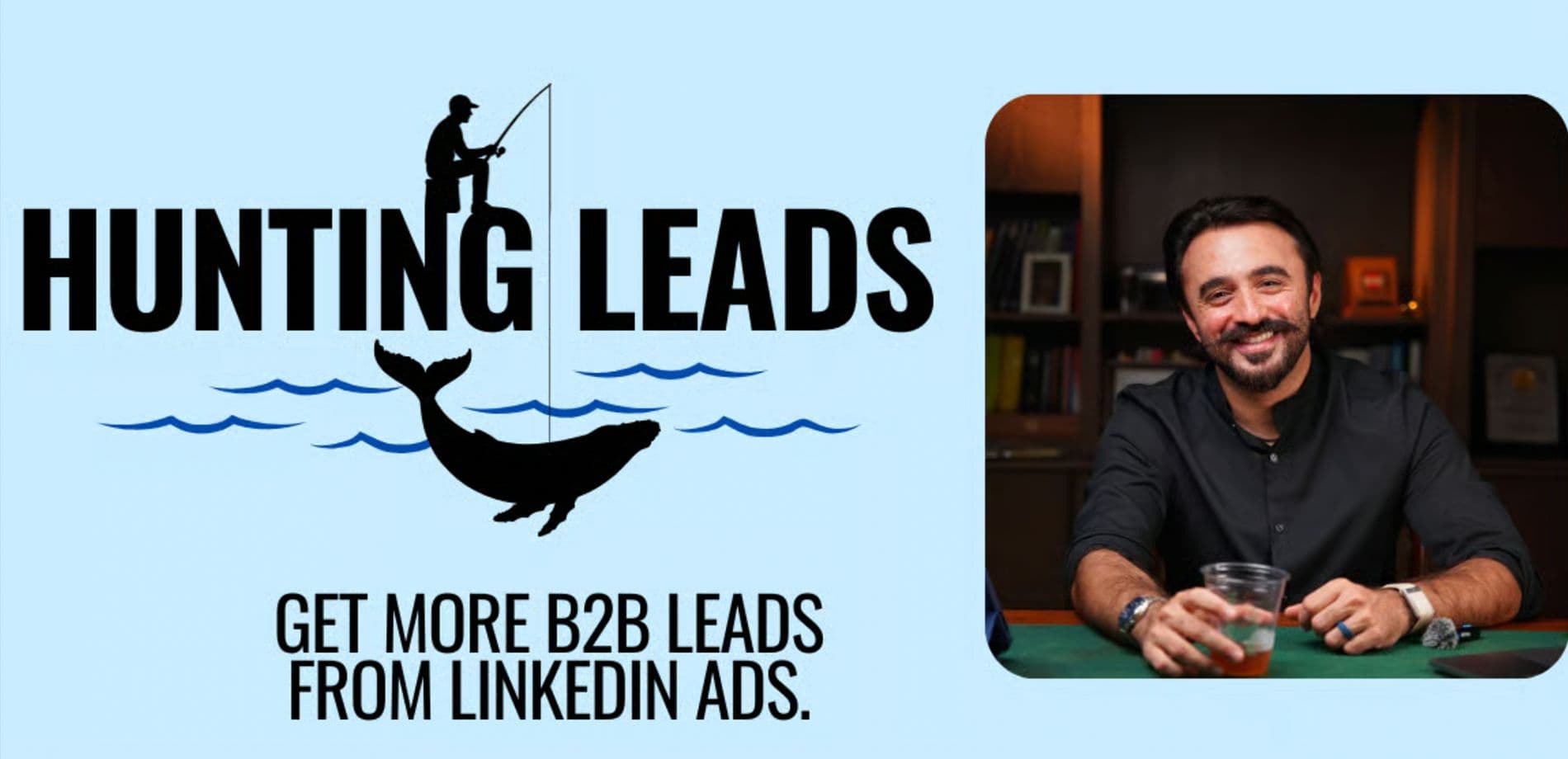
This week's Founder Friday is about a founder who treats paid ads as a craft. With Hunting Leads and his B2B paid ads agency, Moby is building, scaling, and stress-testing paid programs for founders in Austin and beyond. For business owners, the lesson is simple: paid ads are not a hack, they're leverage — but only if you've already proven that someone wants what you're selling.

What's your background? What are you building? What's the story?
My background went from immigrant and bad at school, to engineering operations, which I hated, to marketing, where I failed, and eventually I fell into paid ads. I'm a paid ads nerd for hire. I go into companies and build and scale their paid ad programs.
The moment I fell in love with it was when my first business was failing. I texted my uncle and asked if I could run his paid ads. I'd watched a few YouTube videos. He said sure. We spent $300, and he made $3,500. It broke my brain. From there, I went all in on paid ads and started my agency about seven months ago.
Can you break down what you define as paid ads and the areas you specialize in?
I do LinkedIn, Meta, and sometimes Google, only B2B. The goal is to put an offer in front of someone, whether that's a meeting, a lead magnet, or anything that gets them into our CRM so we can nurture that into a call or a closed deal. The entire goal of paid ads is one conversion that leads to a sale.
What's the difference between paid ads and organic content as a strategy? What are the benefits and drawbacks?
The great thing about paid ads is guaranteed distribution. If you're spending money on Google, you're guaranteed to get in front of people searching for your keywords. On LinkedIn or Meta, you're guaranteed impressions in front of people you're paying to target. You can see the companies, the job titles, the impressions. It's guaranteed distribution of your messaging.
The con is that once you turn it off, it's gone. Hopefully you're building a brand and an email list along the way, but if you were spending $1,000 a day yesterday and stop today, the traffic disappears unless you've captured subscribers or followers.
Organic is the opposite. It's hard to scale, but once it has momentum, it compounds and doesn't turn off. The risk now is AI changing search. People click less, visit fewer websites. But organic doesn't go away the way paid does, unless someone bans you on a social network.
Who are paid ads great for, and who should consider a different strategy?
Speaking from a B2B perspective, paid ads are best for companies that have achieved product market fit or have proven demand. Now you want to spend money to get in front of more of your ideal customers. Your messaging doesn't need to be perfect, but you know it converts.
Cold traffic converts at a lower rate than warm, but you're paying to get in front of the right people. I don't think most people should start a business with paid ads. A lot of e-commerce companies do, but in B2B it's tougher. Paid ads work best for a B2B business looking to scale or a B2C company that's just starting out.
What makes Austin an interesting place for this kind of work?
Austin's a fun town. There's a lot of B2B and B2C here. It has its history in Keep Austin Weird, then Dell brought enterprise companies, and now there are a lot of startups. People here want to grow, even if their goal is more of a lifestyle business than a San Francisco mega-scale company.
I have a lifestyle business myself. Austin has a great startup community where you see other people doing things, and that's how I got into business. I get to see people building massive companies or just starting out, and I'm always able to help, whether through a conversation or a real engagement.
What success stories stand out from the people you've worked with?
A few years ago, a solopreneur came to us. He was a dentist selling a paid mastermind to other dentists. He'd made $40K in year one as a side business. I came on in month two of year two. He brought on a salesperson in month four and an operations person in month two. We spent around $90K, and he went from $40K in year one to $1.12 million in year two. That blew my mind, especially watching how well he tracked everything, including cost per close.
Another one was an AI startup that went from $2 million to $3.7 million in six months after I spent about $300,000 of their money.
The biggest number on my radar I had nothing to do with directly. I consulted for a startup that got acquired for $1.56 billion. It would have been acquired without me, but it's a great number to see. Especially with B2B, and with Meta, things can scale like crazy.
Are there best practices on Meta or LinkedIn that people generally overlook?
I'll go with LinkedIn first because I think about LinkedIn ads way too much. LinkedIn has no algorithm I can find that gets you in front of the right people. On Meta, the algorithm is so good that you don't even need to target. You can say "I want to sell cameras," and Meta will look at your copy and creative and find people interested in cameras because they're in groups or searching outside of Meta.
LinkedIn is a straight-up auction. If you have an audience of 100,000 people, LinkedIn just shows your ads to whoever is online in that audience. It doesn't care if they have any signals matching your product or service. The hard part is that without an algorithm helping you, you have to do the work of really isolating your audience and going after those people. LinkedIn is also two to five times more expensive than Meta per ad, so you have to be careful. It works well, but it takes time and money to get to a point where you can confidently say it works.
Meta is the opposite. You can run ads and get results pretty easily. You won't get the best results that easily, but you can get results. You can spend a little money every month on Meta without hiring someone, especially if you run instant forms. On LinkedIn, you have to be very careful, because it will take your money.
What's the benefit of running a LinkedIn ad if it's so expensive?
Targeting. I've given so much information to LinkedIn. It knows my education, skills, and experience, and it even reads my messages. It puts me into member groups. So if you want to target an advertising agency owner in Texas of a certain employee size, LinkedIn lets you do that. On Meta, you don't have that level of specific targeting. You can find agency owners on Meta, but if I want asset managers at 250 specific property management companies, Meta can't find them. LinkedIn can. That's the value. I wish Meta had that targeting because life would be a lot easier, but right now Microsoft and LinkedIn have that data because we gave it to them.
Is LinkedIn better for B2B, particularly higher ticket products, while Meta might be more compelling for B2C?
A little bit. If you're targeting a broad category like dentists, agency owners, lawyers, or people interested in camera gear, Meta crushes it. If I were running a business where the goal was to get as many SMBs as possible to become my clients and I was going after volume, I wouldn't think about LinkedIn at all. But because I want to work with directors of marketing and VPs of growth at funded SaaS and industrial companies, I can't find those people as well on Meta. LinkedIn has to be the way.
What's the biggest misconception about paid ads?
Quick story. In the 2010s, I was a big Gary Vee and Tim Ferriss fan. I was deep into content marketing. I went to ClickFunnels and a lot of those conferences. I used to believe you should earn customers' attention and not spend money on them. I'd watch videos titled "How to grow your customers without paid ads." I had to overcome that belief and accept that paid ads are great.
They don't waste your money if you do it right. The fear is, what if I spend the money and it doesn't go anywhere? That can happen. But the idea is you're putting money to work, and there's leverage in ad accounts. If I tried to get 50,000 organic impressions for a customer, I'd spend a lot of time on content and SEO. On an ad platform, I have leverage because I have an audience, creative, and money. The two misconceptions I had were that paid ads are bad and that they don't have leverage. I've learned that's wrong. I still believe in organic too.
Are there any people or communities in Austin that have been especially supportive for your growth?
Starting out in the startup world was great. Capital Factory at the time, Div Inc, Mark Nathan's events, all of it was great for me to be around entrepreneurial people, because I didn't have that friend group in college. More recently, Red Fridge has been awesome. It's great for my mental health to be in a community. Your events, Ethan's events.
The environment is here in Austin. If there's a scene you want to belong to, you can find it. No matter how weird it is, you'll find your people. You and I connected at a conference, and now we get to talk about newsletters, paid ads, business, and sponsorships. It's fun to be in a place where you meet people like that.
In the last seven months, what's been your biggest growth lever?
Not necessarily trying to meet new people, but going deeper with the people I already know. Over the last few years, I made an effort to be in marketing communities like Exit 5, Spring, and the Industrial Marketing Summit, and I have a network from the Austin startup scene. So my job on social is just to post more on LinkedIn. My stuff is good, not viral, but that's good enough, because I want people in my network to know what I do so I can get business that way. That goes back to when I was doing this on the side and would have catch-up calls with people just to tell them what I did.
The biggest lever has been paying attention to the people in my audience, getting in front of them, making content for that warm audience, and now moving them to a newsletter, which is the long-term play. It's about showing up for the people I've already met instead of constantly trying to meet new ones. We'll see if that lasts.
For someone coming up in the Austin entrepreneurial scene, maybe starting a business, what advice do you have for them?
This is biased and based on personal experience: meet as many people as you can at the start. Get very comfortable with it. Sales is just meeting people, figuring out what outcome they want, and seeing if you can fit that. It's a soft skill that gets practiced at events.
Going to events is awesome. You never know who you're going to meet. Just get out there. It reminds me of what Scott Galloway said: when you're in your twenties, don't be at your house. Leave in the morning and come back at night. Just come home and sleep. I thought, that's pretty good. You should do that.
Where can people learn more?
Connect with Moby on LinkedIn and subscribe to his newsletter, Hunting Leads.
Want more founder stories?
Subscribe to get weekly interviews and Austin startup news.